-
Issue 57
Issue #57: Education for Democratic Participation Across Places, Cultures, and Peoples
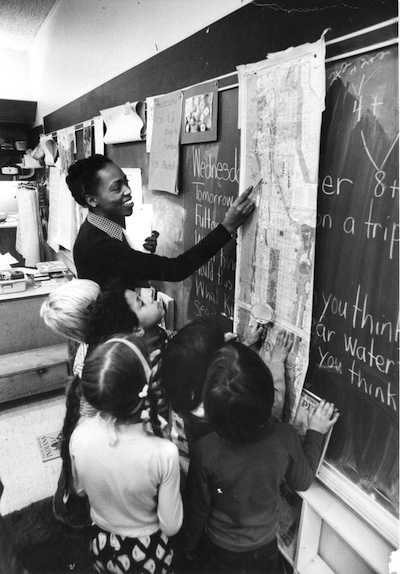 Since the establishment of a free, universal public education system in the 19th century, one of the primary purposes espoused for public schools in the US—as in many other nations—has been to prepare students for citizenship in a democracy. Thus, the Bank Street Occasional Paper Series is launching a timely new issue, #57, to help take stock, assess, and chart a way forward for the relationship between education and democracy. This special issue invites educators, researchers, and policy makers to reflect on how they understand the relationship between education and democracy in this moment, the status of that relationship across different contexts and countries, and how we might imagine this relationship anew.
Over the last several decades in the US and beyond, student, educator, and school success have been measured mostly via math and reading standardized tests, shifting time and focus away from subjects such as social studies, history, and civics. At the same time, publishers have withdrawn many social studies and civic education curricula from the market, resulting in “teachers are shying away from lessons that were once uncontroversial, on topics as basic as constitutional limits on executive power”(Goldstein, 2025).
As many teachers have long understood, these evaporating social studies curricula, while essential, are not alone enough to prepare students to live democratically. Across time and place, educators have worked to make sense of the role of schools in sustaining public life. Bank Street founder Lucy Sprague Mitchell emphasized learning through democratic habits of inquiry embedded in everyday communities (Grinberg, 2005). As stated in the Bank Street credo, Mitchell centered “striving to live democratically, in and out of schools, as the best way to advance our concept of democracy.” Mitchell knew what so many educators and scholars of democracy have noted since: To prepare students for citizenship, schools must go “beyond teaching subject-matter content to develop students’ capacities to understand different perspectives, communicate their understandings to other people, and engage in the give-and-take of moral argument” (Gutmann and Thompson, 1996; p. 359).
Grounded in these longstanding commitments, with an appreciation for educator agency and a keen awareness of the fragility of democracy in the US and beyond in the current moment, this special issue seeks papers that explore and question the relationship between education and democracy past, present and future, across national and state boundaries and from multiple angles—from schools and classrooms to school boards and capitals.
We are seeking essays and manuscripts with a maximum length of 5,000 words as well as short films, audio essays, photo essays, and small-scale artistic works. Issues addressed might include, but are not limited to:
- The relationship between democracy and within-classroom practices and pedagogical strategies
- What education for democracy looks like in early childhood education
- The role of community in how we think about democracy in education
- Explorations of how education and democracy have been conceptualized across different eras, social contexts, communities and identities
- Studies of schools and communities that have maintained a focus on democratic learning amid anti-democratic policies
- Historical analysis of education policies that have supported or compromised educators ability to prepare students for democracy
- Examinations of how civics learning evolves beyond the classroom (e.g., after-school learning, community-based learning, etc.)
Only unpublished materials that are not currently under review by other publications will be considered for evaluation. For further information or to discuss your concepts, please contact guest editors José Vilson, Postdoctoral Fellow, Public Engagement and Research Initiative (PERI), Bank Street College of Education; Amy Stuart Wells, Chief Research Officer, Bank Street College of Education, and Director of PERI; and Xinyu Pan, Postdoctoral Fellow, PERI, Bank Street College of Education, at peri@bankstreet.edu.
Deadline for Submissions: June 1, 2026
References
- Goldstein, D. (October 27, 2025) “How Politics Is Changing the Way History Is Taught.” The New York Times
- Gutmann, A. and Thompson, D. (1996) Democracy and Disagreement: Why Moral Conflict Cannot be Avoided in Politics, and What Should be Done About It. Cambridge, MA: The Belknap Press of Harvard University Press; p. 359
- Schwartz, S. (May 03, 2023). “History Achievement Falls to 1990s Levels on NAEP; Civics Scores Take First-Ever Dive.” Education Week
-
Issue 56
Issue #56: Recovering and Reclaiming Black Education Histories in Teaching and Research

Part of classroom with teacher, Prairie Farms, Alabama.
Photograph by Marion Post Wolcott, March 1939.Please note that the below call is now closed and we are no longer accepting submissions.
As legislation and policies affecting diversity, equity, and inclusion efforts are enacted across various states and internationally, educational stakeholders must be equipped with effective strategies that support the continuation and growth of practices of educational equity. In Issue 56 of the Bank Street Occasional Paper Series, we are highlighting the history of Black educators, whose intellectual, cultural, and political contributions have provided guidance in navigating various sociopolitical currents in education. We look to Black educators’ intricate narratives and histories, their lived experiences and successes. In this special issue, we call for manuscripts that center the vibrant and resilient histories of Black teachers who can shape our understanding of the possibilities of powerful practices of curriculum, pedagogy, advocacy, and activism in these political and social times.
Inspired by Dr. Cynthia Dillard’s work in The Spirit of Our Work (2021), we invite submissions that uplift often forgotten and overlooked stories and pedagogies of Black educators across the history of education in the United States and internationally. Our objective is to cultivate an archive of stories, artifacts, voices, and perspectives that highlight the work of Black educators. Not limited to stories from North America, we recognize the African diaspora in extending the call to the Global South. We aim to feature histories that narrate Black educators’ navigation of the sociopolitical contexts that have influenced schooling, the networks of negotiation they have developed to maintain educational access for communities and families, the approaches to curriculum and pedagogy they have embraced to support their students, and the advocacy systems through which they have continuously worked toward greater educational equality and justice. This process nurtures Dillard’s endarkened feminist praxis framework through (re)searching, (re)envisioning, (re)cognizing, (re)presenting, and (re)claiming to reimagine educational futures through storytelling and research that puts the Black experience at the heart of our journey. We are excited to consider what these educators can teach us both about today’s classroom practices and the future of education research.
We invite teachers, researchers, administrators, community members, policy makers, parents, and other education stakeholders to contribute submissions of essays and manuscripts with a maximum length of 5,000 words. We also welcome short films, audio essays, photo essays, and small-scale artistic works. Questions addressed might include (but are not limited to):
- What erased, obscured, forgotten, or under-highlighted stories of Black educators might support our efforts toward educational equity in contemporary times?
- How can we leverage the stories, histories, and perspectives of Black teachers across the diaspora to maintain liberatory practices in tumultuous political climate?
- What significant Black oral traditions can help us in building towards embodied or living education archives?
- In this time of the erasure of history, what are the affordances of (re)membering in education? What are the implications of disremembering, the right to forget, and the politics surrounding being forgotten?
Only unpublished materials that are not currently under review by other publications will be considered for evaluation. While not mandatory, we encourage interested individuals to contact the editors to propose ideas and obtain feedback and assistance. For further information or to discuss your concepts, please contact the guest editors, Mariah Harmon at mth5601@psu.edu or Taryrn T.C. Brown, at taryrnbrown@coe.ufl.edu.
Deadline for Submissions: December 1, 2025